
A $9.4 billion network of long-distance power lines will be built across the eastern swath of Texas to create a new “superhighway” for the state’s power grid, after state officials voted unanimously to approve the plan this week.
By Elena Bou, Contributor
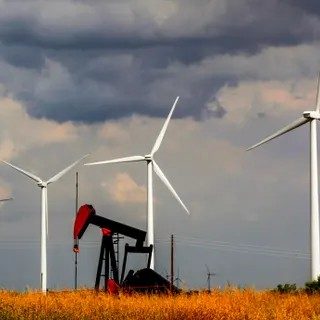
What comes to mind when you think of Texas? Friday night football under floodlights, wide horizons, brisket and country music – a fierce sense of independence. But also oil derricks against a burnt-orange sky and refineries lining the Gulf Coast.
Energy abundance is woven deep into the state’s identity. What is changing now is how that abundance is being produced. Texas is building one of the largest new energy systems in the Western world – not because it turned politically green, but because market forces are making clean energy the fastest and most scalable way to meet surging demand.
This shift is economic, not ideological.
By Sarah Grunau
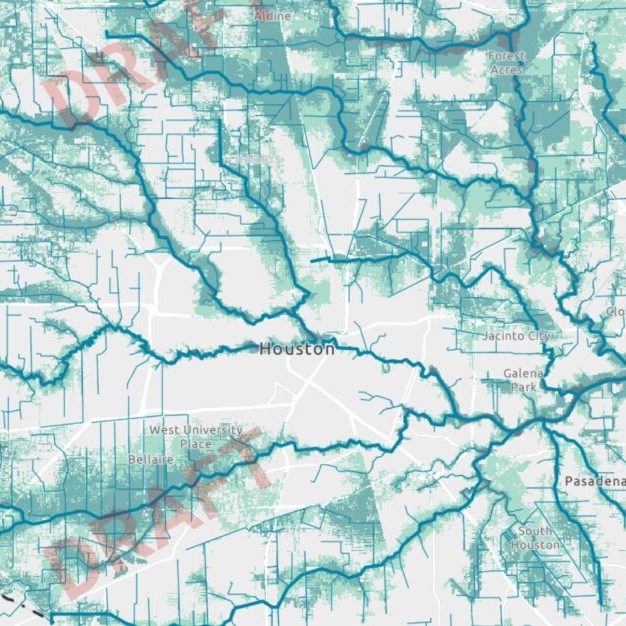
A newly proposed Harris County flood zone map adds heightened flood risks for households across the Houston area.
A draft of the Federal Emergency Management Agency’s new and long-awaited flood risk map will likely go through several variations before final approval. The map — which was quietly released on the agency’s website two weeks ago and intended for technical reviews by floodplain administrators — marks a major revision in Harris County’s flood risk zones that haven’t seen a comprehensive update in nearly 20 years.
Under the proposed map — which will influence insurance coverages as well as local development rules — the 100-year and 500-year floodplains widely expanded in south Houston, while some areas in southwest Houston saw a reduced flood risk. Both floodplains appeared to spread in northeast Harris County near Lake Houston under the proposal.
Jim Blackburn, an environmental law professor at Rice University, said that a reevaluation of rainfall rates is one of the most significant developments since the county’s previous flood maps were released in 2007. The federal agency’s newly proposed map reflects about a 30% increase in rainfall rates.
By , Staff Writer
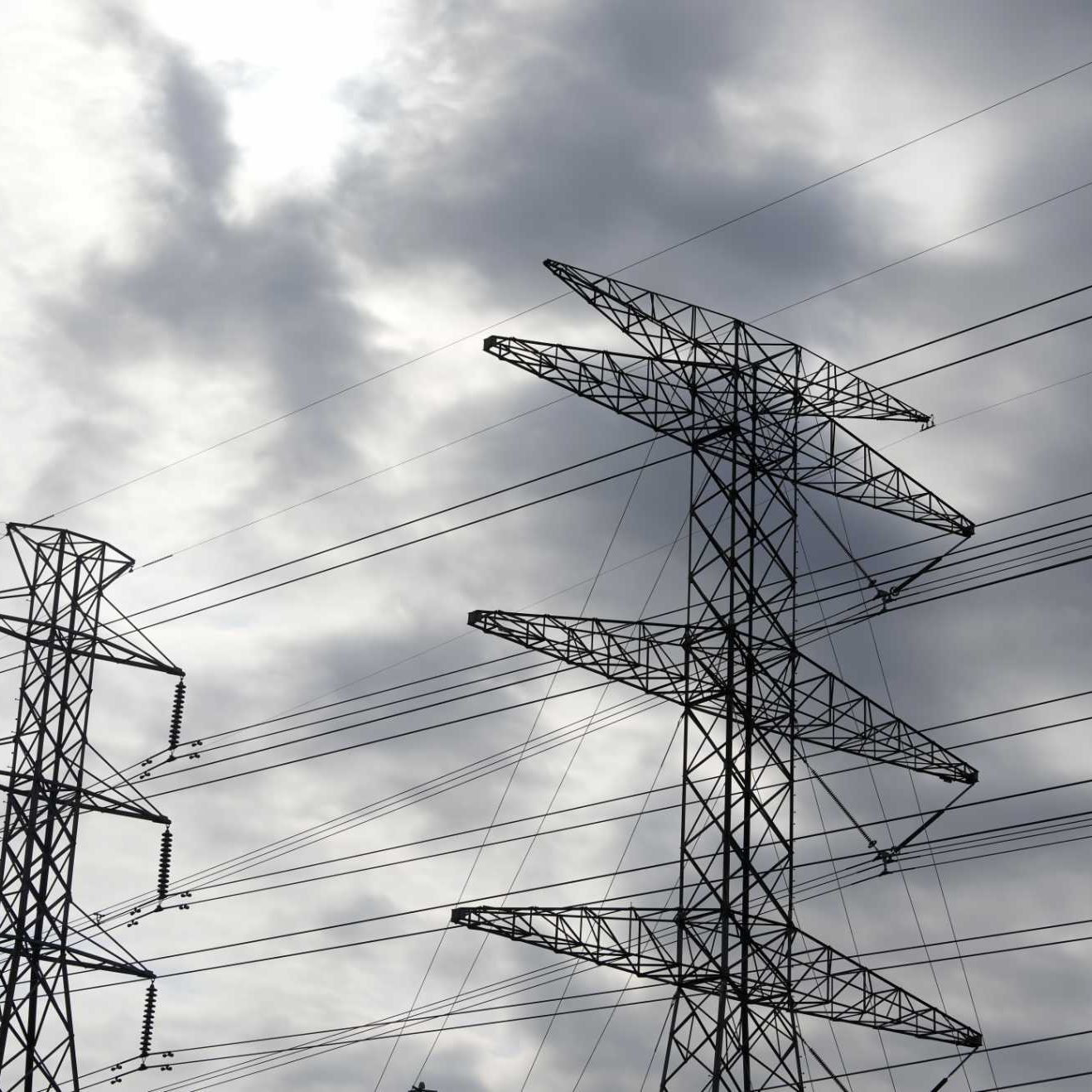
The project, made up of more than 1,100 miles of power lines and transmission towers, would cut through the Houston area, though exact routes haven’t been determined yet.
Once completed in the early 2030s, the 765-kilovolt power lines would be able to carry more than twice as much electricity as the existing 345-kilovolt power lines across the state.
This new “superhighway” is needed so that the state’s power grid can keep the lights on amid an expected boom in electricity demand in the coming years, said Kristi Hobbs, vice president of system planning for the Electric Reliability Council of Texas.
ERCOT manages the power grid that serves most of the state’s electricity demand. By 2031, that demand could increase more than 70%, according to ERCOT’s forecasts, primarily because of electrification in the oil and gas industry and an influx of data centers powering artificial intelligence technologies.
“We realized we could not keep planning the system the way we always had,” Hobbs told ERCOT’s board during the grid operator’s quarterly meeting this week.
By Janet Miranda – Reporter, Houston Business Journal
Seventeen years after Hurricane Ike devastated Galveston, the region’s long-anticipated storm barrier — known as the “Ike Dike” — has achieved a significant milestone.
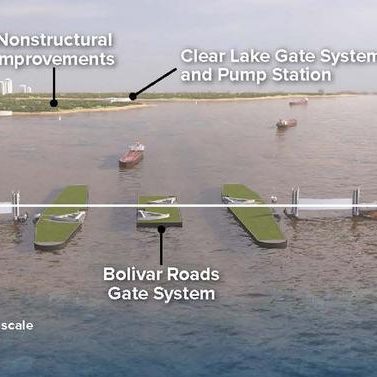
The Gulf Coast Protection District recently approved two major engineering design contracts, advancing the largest coastal protection initiative in the U.S. Dallas-based Jacobs (NYSE: J) secured the contract for designing the Bolivar Roads Gate System, also known as “The Gate,” which will span the 2-mile-wide waterway separating Galveston Island from Bolivar Peninsula.
Omaha-based HDR Inc. will design the Bolivar and West Galveston Beach and Dune System, a project focused on restoring vital coastal ecosystems and reinforcing natural barriers in the region.
Spanning from Galveston Bay to South Padre Island, the project represents a comprehensive risk-management strategy for Texas’s coastline. It employs multiple lines of defense to reduce storm surge threats and restore damaged coastal ecosystems.
“Everyone’s been waiting to see some progress on this project,” said Heather Betancourth, the Gulf Coast Protection District’s communications director. “We can’t get to construction without moving those two features in design, so it’s really the first step to kind of realize the bigger portion of this project.”
By TPR Staff
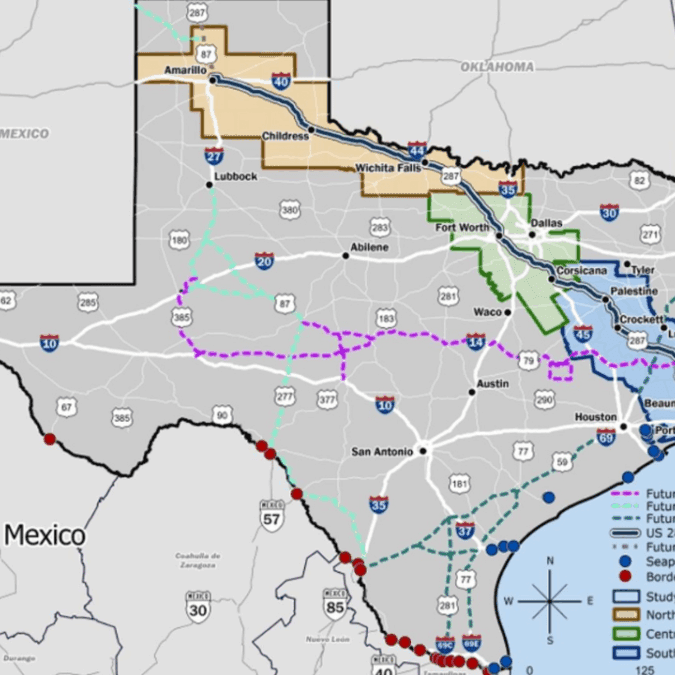
Texas is once again in the middle of a major transportation conversation, and this time the discussion centers on whether the state could see two entirely new interstate corridors built over the next several decades. While Texans are familiar with continuous population growth and the resulting strain on transportation networks, the scale of the projects under consideration is unusually large. Between the federally authorized I-14 System and the Texas Department of Transportation’s (TxDOT) new study on converting US 287 into an interstate, Texas could be looking at some of the most significant highway developments since the original Interstate Highway System.
These proposals come at a time when Texans are increasingly aware of the rising cost of infrastructure, the limits of government funding, and the long-term financial obligations tied to mega-projects that unfold over decades. The promise of new interstates often sounds appealing, but the reality involves federal designation hurdles, environmental reviews, land acquisition, and enormous construction costs that taxpayers ultimately bear. Understanding these projects requires comparing the benefits they offer with the concerns raised by both residents and fiscal watchdogs.
What follows is a comprehensive look at the I-14 System’s progress and the future of US 287 as a potential interstate, drawing from TxDOT’s official planning documents, public engagement summaries, and statewide projections.

By Naomi Klinge – Reporter, Houston Business Journal
A joint venture of midstream companies reached a final investment decision on a new natural gas pipeline from the Permian Basin to Katy.
The Matterhorn joint venture involves Tulsa, Oklahoma-based Oneok Inc. (NYSE: OKE), Austin-based WhiteWater, Ohio-based MPLX LP (NYSE: MPLX) and Canada-based Enbridge Inc. (NYSE: ENB), which has its U.S. headquarters in Houston.
The joint venture is developing the new 450-mile Eiger Express Pipeline, which is designed to transport up to 2.5 billion cubic feet per day of natural gas from the Permian Basin to Katy and will hold reserved capacity for deliveries to the Corpus Christi market.
The Matterhorn joint venture owns 70% of the Eiger Express Pipeline, while both Oneok and MPLX also own additional 15% stakes separate from the JV. Combined with their stakes in the JV, Oneok and MPLX own 25.5% and 22%, respectively, of the new pipeline.
By Giulia Carbonaro – US News Reporter
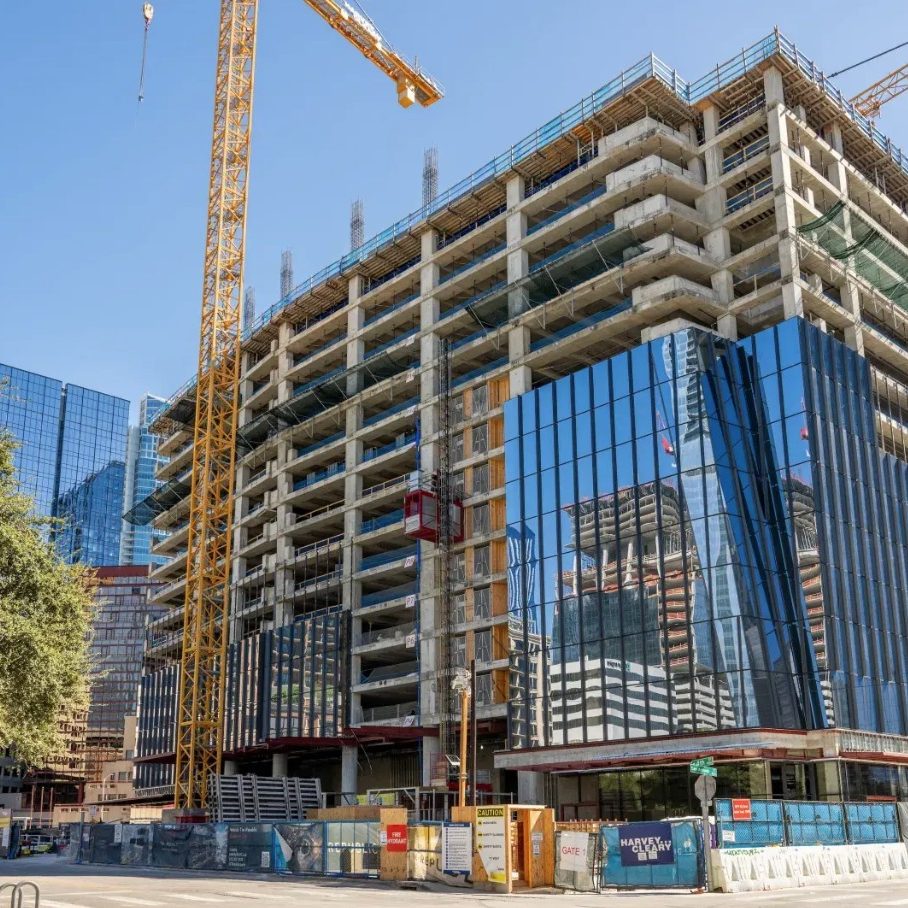
Texas lawmakers trying to solve the state’s housing affordability crisis passed a bill during the last legislative session that experts say will be a “game-changer” for the development of multifamily homes.
Senate Bill 840 or SB 840, which was introduced by Republican state Senator Bryan Hughes and signed into law by Governor Greg Abbott in June, would streamline the process of turning non-residential commercial buildings in the state into mixed-use and multi-family residential ones.
Under the new legislation, any land that is already classified as a zone for office, commercial, retail, warehouse or existing mixed uses could be turned into mixed-use residential housing without the need for a zone change. Essentially, the legislation does away with a process that some have complained can be time-consuming and expensive—at least in some cases.
By Tian Su at Texas A&M University
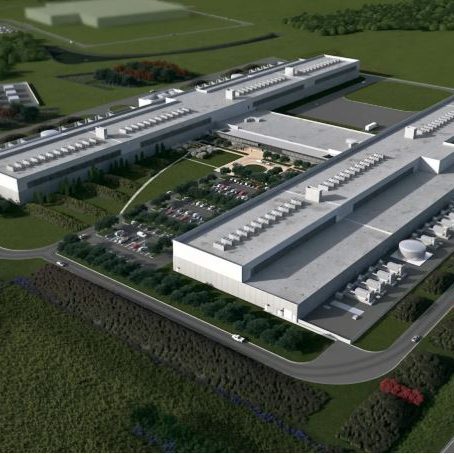
In a remarkably short time, Texas has positioned itself as a for data centers, a niche but rapidly expanding asset class that demands highly specialized construction, robust power infrastructure, and proximity to major fiber routes. For real estate investors and developers, this isn’t just another wave of tech expansion—it’s one of the most infrastructure-intensive and, if the tech trend continues, future-proofed opportunities in commercial real estate today.
The Boom
Between 2023 and 2024, Central Texas, particularly around Austin and San Antonio, witnessed a four-fold increase in data center construction, totaling 463.5 megawatts (MW) of potential demand under development. This surge positioned the region as the second-largest data center market in the U.S., trailing only Northern Virginia ().
Notable developments included $500 million, 180,000-square-foot data center and a 13,000-square-foot flex office space at 2351 Innovation Blvd, located at the intersection of SH 130 and West US 79 in Williamson County, and in Cedar Creek. These projects not only spurred local economic growth but also significantly influenced land markets. The demand for tracts of land suitable for data center development led to increased land sales, particularly in areas with access to reliable power and fiber infrastructure.
Why Texas?
The state’s vast land availability, business-friendly regulations, and relatively affordable power (compared to coastal states) make it an attractive location for major tech firms and hyperscale operators. Beyond these practical benefits, Texas has several other key advantages that are fueling this growth:
- Central time zone: Texas’s central time zone offers an edge for global operations. For the most part, the state is also inland, meaning there are fewer risks from hurricanes, earthquakes, or coastal flooding. That geographic safety makes for more stable uptime guarantees, which are promises providers in data centers make to keep their systems stay online and operational almost all of the time.
- Proximity to key infrastructure: Texas is a prime location for data centers due to its robust infrastructure, including a vast network of highways, fiber optic cables, and access to critical power grids.
- Abundant renewable energy: Texas leads the U.S. in wind power and is rapidly scaling solar, which makes it a prime location for energy-hungry data centers looking to meet sustainability goals (). For sustainability-conscious companies like Microsoft, Meta, and Google, this makes Texas a prime destination to hit decarbonization targets.
- Lower Operating Costs: Compared to coastal tech hubs such as Silicon Valley or New York, Texas offers lower overall costs of doing business.
While property taxes in Texas are generally higher than in many other states, some communities offer property and sales tax abatements to attract businesses. Additionally, Texas generally has fewer regulatory hurdles, making it easier and more cost-effective for companies to operate and expand.
Power and Land Demands and Challenges
The Electric Reliability Council of Texas (ERCOT) that peak electricity demand for Texas could reach 218 gigawatts (GW) by 2031, more than double the 2023 record of 85.5 GW. Data centers are expected to account for the largest percentage of this growth, driven by the energy requirements of artificial intelligence (AI) and cloud computing services.
Meeting this demand will require a major expansion of Texas’ power generation capacity, whether through new renewable energy installations or additional natural-gas-fired plants. Either path carries substantial implications for land use, from sprawling solar farms and wind arrays to traditional power plants and supporting infrastructure.
The demand for land suitable for data center development not only means more sales but also transformed land-use patterns. For example, in the Permian Basin, traditionally known for oil and gas production, companies like are repurposing land for data center sites. These developments are equipped with necessary infrastructure, including power, broadband, and water for cooling, and are strategically located to leverage existing energy resources.
Texas Land Market’s Future
The Trump administration’s policies have played a pivotal role in promoting data center growth in Texas. Announced in January 2025, the Stargate Project is an ambitious $500 billion initiative aimed at establishing a nationwide AI infrastructure. The project plans to construct up to 20 data centers across the United States, with Texas serving as a central hub. These would bring demand for large utility-ready parcels.
The AI revolution isn’t just happening online, it’s being built acre by acre right here in Texas. What began as a quiet tech migration has become a full-on infrastructure rush. In Texas, land is no longer just land—it’s also bandwidth, energy, and scalable infrastructure.
Views expressed on The 338 are those of the authors and do not imply endorsement by the Texas Real Estate Research Center, Division of Research, or Texas A&M University.
Article featured at https://trerc.tamu.edu/blog/ai-land-and-power-inside-texas-data-center-explosion/
Photo: Texas A&M University
By Hailea Schultz with Greater Houston Partnership
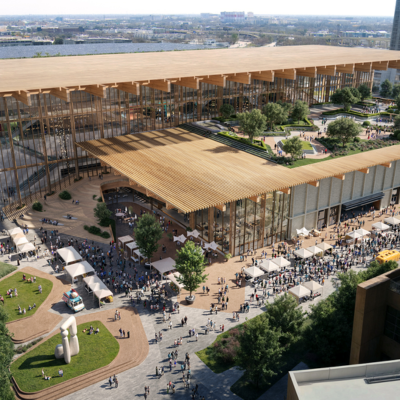
The George R. Brown Convention Center (GRB) is set to undergo a major transformation that will reimagine downtown Houston into a pedestrian-friendly convention and entertainment district.
Mayor John Whitmire and Houston First Corporation recently unveiled a master plan for the project, marking the first substantial renovation since 2016, which opened the building to Discovery Green and created the Avenida Houston Plaza.
The $2 billion project aims to bolster Houston’s position as a global hub for sports, entertainment and tourism, an especially timely investment as the city prepares to host FIFA World Cup matches in 2026 and the Republican National Convention in 2028.
The first phase of development includes a 700,000-square-foot building, GRB Houston South, which will serve as a key connector between downtown and Houston’s East End. The building will include two exhibit halls, a multipurpose hall opening to the new Central Plaza, an atrium flex hall, ground-level retail and dining spaces and what is set to be the largest ballroom in Texas.
Additionally, the Avenida Plaza will be extended south to connect Discovery Green with the new Central Plaza, creating an expanded gathering space for large-scale events and community activities.
The project’s design is inspired by Houston’s bayous and natural prairie landscape. Along with its nature-inspired elements, the building will use eco-friendly materials and energy-efficient systems, including rainwater collection and water-saving features, to minimize its environmental impact and strengthen the city’s sustainability efforts.
The groundbreaking project will be funded by a portion of the state’s hotel tax revenue, made possible by Senate Bill 1057, which passed in 2023.
The Need for Expanded Infrastructure
With Houston’s hospitality and tourism industry rapidly expanding, the demand for expanded infrastructure has never been greater. In 2024, the city welcomed more than 54 million visitors, an increase of six percent from 2023 and nearly 10 percent since 2019, according to Houston First.
GRB Houston South is scheduled to open in May 2028, with the full project expected to be completed by 2038.
Article featured at https://www.houston.org/news/george-r-brown-convention-centers-2-billion-transformation-project
Photo: Greater Houston Partnership
By Apple.com
Teams and facilities to expand in Michigan, Texas, California, Arizona, Nevada, Iowa, Oregon, North Carolina, and Washington
Plans include a new factory in Texas, doubling the U.S. Advanced Manufacturing Fund, a manufacturing academy, and accelerated investments in AI and silicon engineering
CUPERTINO, CALIFORNIA Apple today announced its largest-ever spend commitment, with plans to spend and invest more than $500 billion in the U.S. over the next four years. This new pledge builds on Apple’s long history of investing in American innovation and advanced high-skilled manufacturing, and will support a wide range of initiatives that focus on artificial intelligence, silicon engineering, and skills development for students and workers across the country.
“We are bullish on the future of American innovation, and we’re proud to build on our long-standing U.S. investments with this $500 billion commitment to our country’s future,” said Tim Cook, Apple’s CEO. “From doubling our Advanced Manufacturing Fund, to building advanced technology in Texas, we’re thrilled to expand our support for American manufacturing. And we’ll keep working with people and companies across this country to help write an extraordinary new chapter in the history of American innovation.”
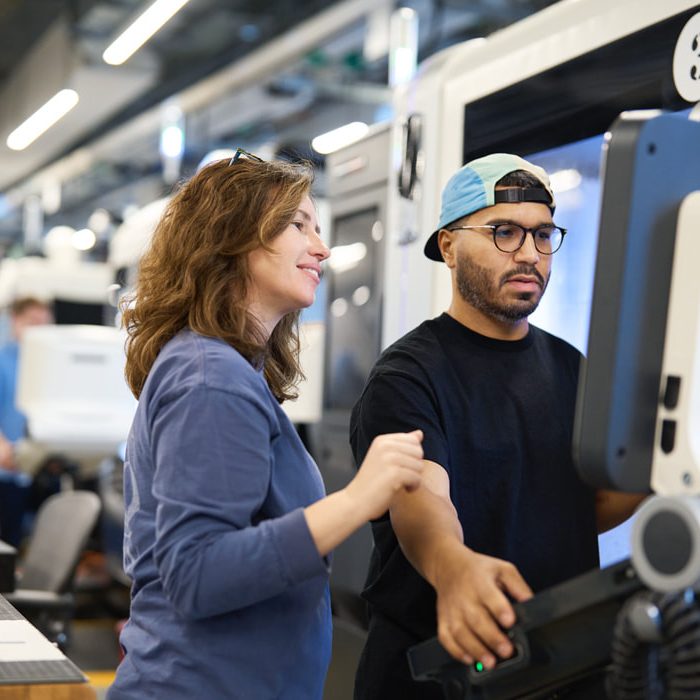
As part of this package of U.S. investments, Apple and partners will open a new advanced manufacturing facility in Houston to produce servers that support Apple Intelligence, the personal intelligence system that helps users write, express themselves, and get things done. Apple will also double its U.S. Advanced Manufacturing Fund, create an academy in Michigan to train the next generation of U.S. manufacturers, and grow its research and development investments in the U.S. to support cutting-edge fields like silicon engineering.
The $500 billion commitment includes Apple’s work with thousands of suppliers across all 50 states, direct employment, Apple Intelligence infrastructure and data centers, corporate facilities, and Apple TV+ productions in 20 states. Apple remains one of the largest U.S. taxpayers, having paid more than $75 billion in U.S. taxes over the past five years, including $19 billion in 2024 alone.
Today, Apple supports more than 2.9 million jobs across the country through direct employment, work with U.S.-based suppliers and manufacturers, and developer jobs in the thriving iOS app economy.
Opening a New Manufacturing Facility in Houston
As part of its new U.S. investments, Apple will work with manufacturing partners to begin production of servers in Houston later this year. A 250,000-square-foot server manufacturing facility, slated to open in 2026, will create thousands of jobs.
Previously manufactured outside the U.S., the servers that will soon be assembled in Houston play a key role in powering Apple Intelligence, and are the foundation of Private Cloud Compute, which combines powerful AI processing with the most advanced security architecture ever deployed at scale for AI cloud computing. The servers bring together years of R&D by Apple engineers, and deliver the industry-leading security and performance of Apple silicon to the data center.
Teams at Apple designed the servers to be incredibly energy efficient, reducing the energy demands of Apple data centers — which already run on 100 percent renewable energy. As Apple brings Apple Intelligence to customers across the U.S., it also plans to continue expanding data center capacity in North Carolina, Iowa, Oregon, Arizona, and Nevada.
Doubling Apple’s U.S. Advanced Manufacturing Fund
As part of this new investment, Apple is doubling its U.S. Advanced Manufacturing Fund, which was created in 2017 to support world-class innovation and high-skilled manufacturing jobs across America. The growing commitment will increase the fund from $5 billion to $10 billion, focused on promoting advanced manufacturing and skills development throughout the country.
The fund’s expansion includes a multibillion-dollar commitment from Apple to produce advanced silicon in TSMC’s Fab 21 facility in Arizona. Apple is the largest customer at this state-of-the-art facility, which employs more than 2,000 workers to manufacture the chips in the United States. Mass production of Apple chips began last month.
Silicon used by Apple is designed to bring Apple users incredible features, performance, and power efficiency across their devices. Apple’s suppliers already manufacture silicon in 24 factories across 12 states, including Arizona, Colorado, Oregon, and Utah. The company’s investments in the sector help create thousands of high-paying jobs across the country at U.S. companies like Broadcom, Texas Instruments, Skyworks, and Qorvo.
To date, Apple’s U.S. Advanced Manufacturing Fund has supported projects in 13 states — including Kentucky, Pennsylvania, Texas, and Indiana — that have helped build local businesses, train workers, and create a wide range of innovative manufacturing processes and materials for Apple products.
Growing R&D Investments Across the U.S.
Apple continues to expand its R&D across the U.S. In the past five years, Apple has nearly doubled its U.S.-based advanced R&D spend, and it will continue to accelerate its growth.
Recently, Apple announced the newest addition to its iPhone lineup, iPhone 16e. iPhone 16e delivers fast, smooth performance and breakthrough battery life, thanks to the industry-leading efficiency of the A18 chip and the new Apple C1 — the first cellular modem designed by Apple, and the most power-efficient modem ever on an iPhone. Apple C1 adds a new chapter to the story of Apple silicon and is the result of years of R&D investment, bringing together the work of thousands of engineers. Apple C1 is the start of a long-term strategy that will allow Apple to innovate and optimize the modem system for additional Apple products.
In the next four years, Apple plans to hire around 20,000 people, of which the vast majority will be focused on R&D, silicon engineering, software development, and AI and machine learning. The expanded commitment includes significant investment in Apple’s R&D hubs across the country. This includes growing teams across the U.S. focused on areas including custom silicon, hardware engineering, software development, artificial intelligence, and machine learning.
Supporting American Businesses with a New Manufacturing Academy in Detroit
To help companies transition to advanced manufacturing, Apple will open the Apple Manufacturing Academy in Detroit. Apple engineers, along with experts from top universities such as Michigan State, will consult with small- and medium-sized businesses on implementing AI and smart manufacturing techniques. The academy will also offer free in-person and online courses, with a skills development curriculum that teaches workers vital skills like project management and manufacturing process optimization. The courses will help drive productivity, efficiency, and quality in companies’ supply chains.
Apple has long been committed to investing in education and skills development for American workers and students. That includes ongoing and expanding grant programs for organizations like 4-H, Boys & Girls Clubs of America, and FIRST, which work closely with Apple in communities across the country to create free programming that helps young people learn vital skills like coding.
Apple’s support for the next generation of innovators also includes efforts like the company’s New Silicon Initiative, which prepares students for careers in hardware engineering and silicon chip design. Last year, this program expanded to students at Georgia Tech, and it now reaches students at eight schools across the country. Apple is continuing to expand the initiative, including a new collaboration with UCLA’s Center for Education of Microchip Designers (CEMiD) beginning this year.
Article featured at https://www.apple.com/newsroom/2025/02/apple-will-spend-more-than-500-billion-usd-in-the-us-over-the-next-four-years/
Photo: Apple